Monday, 20 May 2013
The power of a home visit

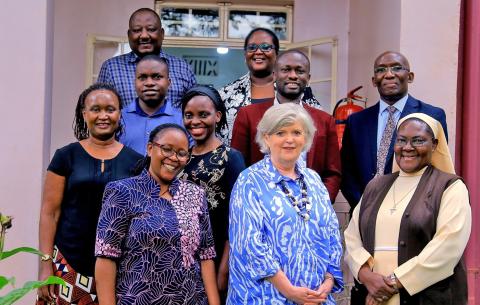
Travelling through the winding roads of rural Uganda, where sickness is often attributed to witchcraft and treatment is therefore neglected, APCA's small grants manager, David Byaruhanga, joined a team of donors visiting patients in their homes. As Africa's patients often lack the financial means to travel to a hospital and are often too weak to make the journey, home-based care brings both treatment and hope to their doorstep.

Touched by the experiences of the patients visited through Rays of Hope Hospice Jinja, David captures the manner in which doctors, nurses, partner organisations, and donors make palliative care accessible where medical intervention is limited -- and he invites us to share in the journey.


Visit to a young man with cancer of the eye
Our first visit took us to a 20 year old patient living with cancer of the eye. His case started as a small pimple, which was removed by the health unit personnel who were unaware that it was a developing cancer. The wound later began to swell and could not heal. In this young man's rural community, the case was first attributed to witchcraft, which resulted in a delay toward his seeking medical treatment from a hospital. When the swelling had increased, eventually covering his whole face, the patient was referred by ambulance to Mulago Hospital. At Mulago, the patient and his family could not believe the news they were told by the doctors at the Cancer Institute: "It's too late for any radiotherapy or chemotherapy intervention to make a difference; take back your patient and look after him well." That was the fate of the young man who was in senior three in 2007 -- all his dreams were shattered in an instant.

In 2008, Rays of Hope Jinja Hospice enrolled the young man into their hospice programme and the patient has had no regrets since. The hospice team visits him twice a month and provides him with morphine for pain control and routine counselling to the family members. The family couldn't have coped well with the patient without the support from the hospice team, especially in dealing with the septic wounds that overshadowed his eyes and in dealing with the pain the young man was enduring. With hospice support, the patient is living without pain, able to eat and is living in the same household with the rest of his family members.

Visit to a patient in extreme poverty
The second home visit was to a patient with HIV and AIDS suffering from cancer of the skin (Kaposi sarcoma). This was a man in his early 40s who delayed to enroll in HIV treatment programmes as his sickness was also attributed to witchcraft. The cancer affected his right foot, swollen with blisters and wounds that look like elephantiasis spreading to the left leg. The patient has no wife and is cared for by his elderly mother. Since his treatment began to include Septrin, his condition has greatly improved, according to the Jinja Rays of Hope Hospice team.  His wounds no longer emit a foul smell as the hospice team provided medicine in a liquid form that he uses to immerse his foot to ensure the wounds remain consistently clean.

The family lives in dire poverty and their lack of an income has resulted in limited access to health care services as they cannot afford transport to the nearest health centre to access HIV services. In addition, a shortage of food is a regular occurance in the household as they admit to occasionally missing meals, which definitely impacts the immunity levels of the patient. The visitors noted that the patient's land is fertile and the family can grow food crops and vegetables to consume at home, rather than lamenting about the shortage of food. This observation raises an important point about integrating livelihood support into palliative care to bolster the nutrition levels of patients living in poverty.

Visit to a patient born with HIV
Our last visit was an outreach to HIV patients at the Buwenge health centre where we were welcome by one of the Rays of Hope volunteers, trained through a True Colours Trust grant. At the centre, we met a young 17 year old girl who had a particularly moving story.

The girl had developed lesions on her body and was experiencing a lot of pain. She told her story of how she was born with HIV and currently is on ARVs. Despite the medication, her health status has not improved significantly as she has little to eat. Although morphine has been prescribed to the young woman for pain relief, she cannot take it on an empty stomach. This young girl lost her father and stays with her mother who apparently also looks after other orphans and cannot meet all the needs of her family. The mother's situation is so dire, a number of her children have ventured out to look for means of economic survival, irrespective of the risks involved.

Stigma is still pervasive in fuelling the spread of mother to child transmission of HIV and we witnessed cases where HIV positive mothers were still breastfeeding. Although they know it's risky to breastfeed a baby after six months, many women continue with the practice to avoid questions from their community members. A lot of advocacy and awareness still needs to be done in regards to HIV prevention and to address stigma and discrimination.

The trip back home

Although there was still a lot still to see, we had to travel back to Kampala. While on the road, the memories and stories from the field caused everyone in the vehicle to travel in silence and none of the visitors had an appetite for lunch. On the road, a lingering question remained in my mind: How does the hospice team in Jinja manage to persevere in this kind of work, listening to painful stories over and over and traveling such long distances to reach patients? My conclusion is that Rays of Hope Hospice Jinja are indeed true to their name -- providing patients and their families with a ray of hope to be supported and to live for the next day.

Comments (1)