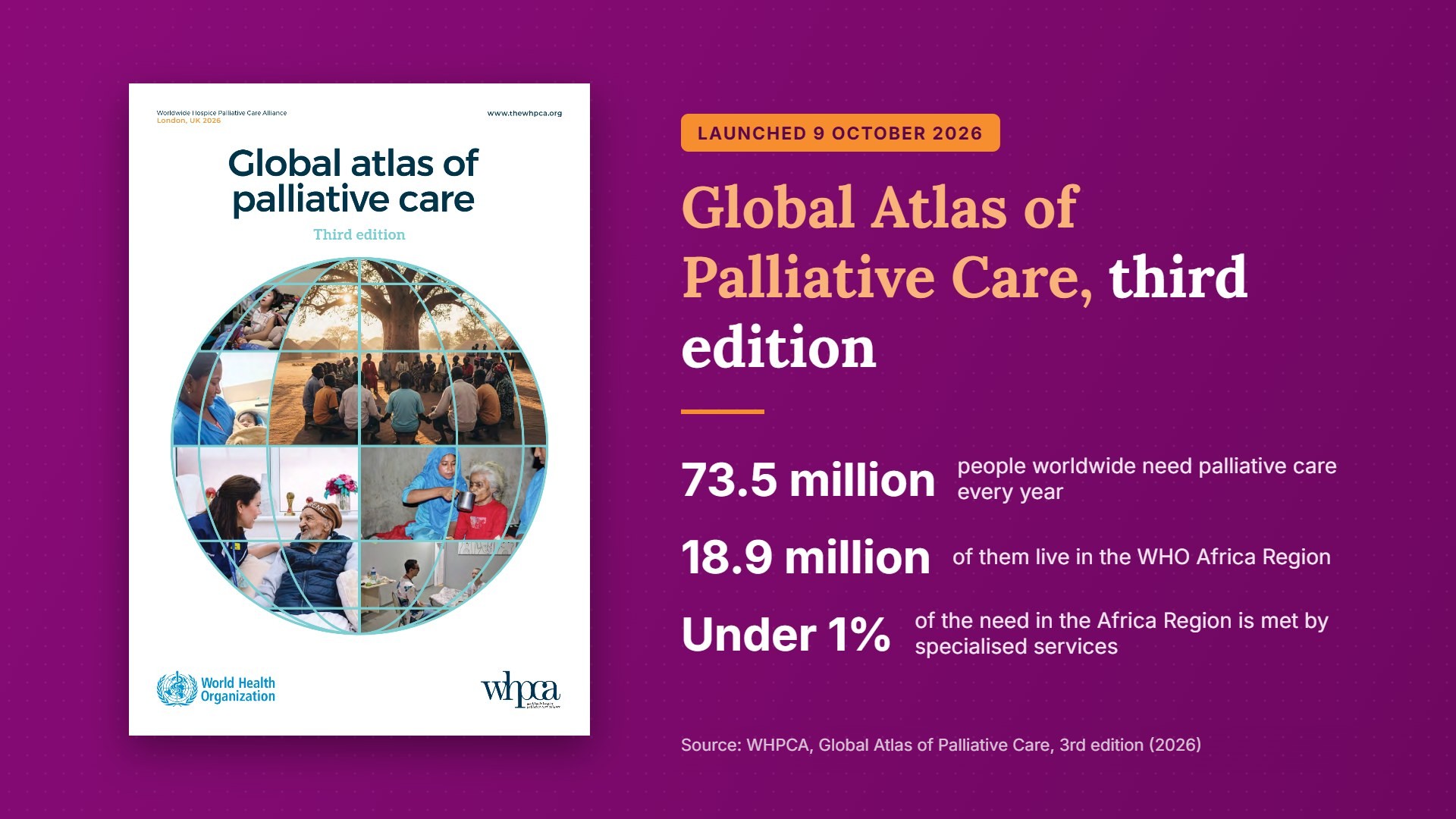
The third edition of the Global Atlas of Palliative Care was launched on 9 October 2026 at the morning plenary of the International Palliative Care Congress in Montreal. Published by the Worldwide Hospice Palliative Care Alliance (WHPCA), with technical input and review from the World Health Organization (WHO), the Atlas is the most comprehensive picture of how palliative care is developing around the world.
Edited by Stephen R. Connor (WHPCA) and William E. Rosa (Memorial Sloan Kettering Cancer Center), the new edition updates the Atlas first published in 2014 and revised in 2020. It sets out how many adults and children need palliative care, the main barriers to care, how services are developing in every country, and the way forward.
Download the Global Atlas (PDF)
The global picture
The Atlas shows real progress, but the gap remains wide. Worldwide, specialised services reach about 14% of the people who need them. In low and middle income countries, only 4.4% of the need is being met.
What the Atlas says about Africa
- The highest need relative to population. The Africa Region has the greatest need for adult palliative care per 100,000 people (2,161), driven largely by HIV, which accounts for 66.5% of serious health related suffering in the region.
- Children carry the heaviest burden. The need for children's palliative care is 936 per 100,000 children in the Africa Region, the highest of any region. Specialist children's palliative care services are available in only 21 of Africa's 54 countries.
- Uneven development across countries. Of the region's 47 countries, Uganda is the only one classed as Advanced. South Africa, Malawi, Kenya and Rwanda are classed as Established, 16 countries as Progressing, and 26 as Emerging.
- African models leading the way. The Atlas features case studies from Ethiopia (adults) and South Africa (children), the "Hi-Five" workforce model developed by the Kenya Hospice and Palliative Care Association with WHPCA, and palliative care for refugees in Uganda. It also cites APCA's Standards for Providing Quality Palliative Care as an example of bereavement support built into continental strategy.
The Atlas notes that encouraging advances in parts of Africa show meaningful development is achievable beyond high resource settings, provided there is political commitment, strategic resource allocation and locally adapted models of care.
APCA's role
APCA's Executive Director, Dr Eve Namisango, serves on the WHPCA Board of Trustees. The new evidence reinforces the case APCA makes every day with governments, training institutions and partners across Africa: palliative care must be integrated into health systems at every level, so that every person living with serious illness can get the care they need.
We encourage everyone working in palliative care to read the Atlas and share it widely with colleagues, policymakers and partners.
Download the Global Atlas (PDF)
Source: Connor, S.R., & Rosa, W.E. (Eds.). (2026). Global Atlas of Palliative Care (3rd ed.). London: Worldwide Hospice Palliative Care Alliance.


